

The Space Force Space Systems Command recently released an RFI for the Space Data Network (SDN) Mission Operations Center (MOC). On the surface, it reads like a broad market survey covering networking, satellites, operations, security and sustainment.
But read closely, and something else emerges: this RFI isn’t really asking what industry can build. It is asking how they think about delivering and evolving software in a highly uncertain, multi-vendor environment.
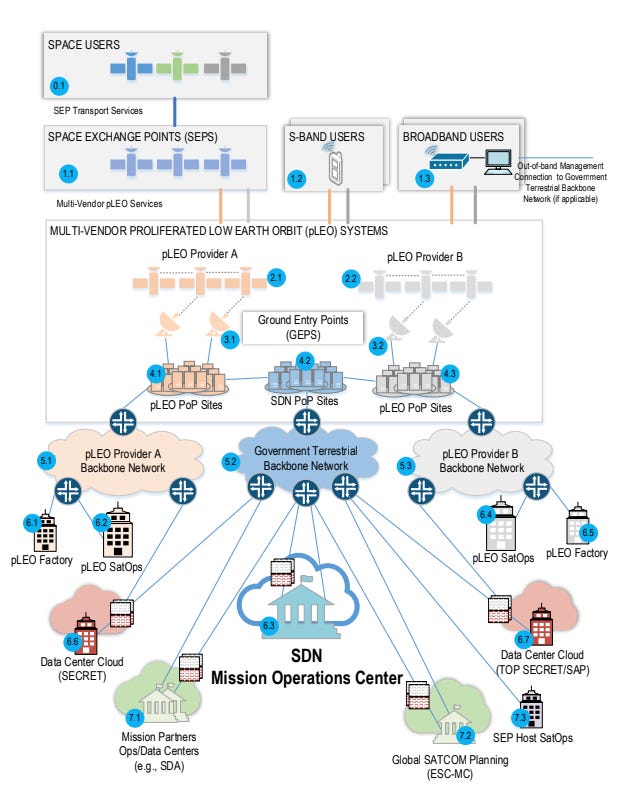
A common response from industry may be to align to a more traditional FAR-style approach, including architecture diagrams, end-state designs, exhaustive claims of end-to-end responsibility. All in the effort to cover the entire complex landscape.
Ironically, that kind of response may be more likely to push the government away from modern software acquisition under the new rules, instead of toward it.
The Software Acquisition Pathway exists precisely for problems like this: requirements are not fully known up front, multiple commercial and government providers must integrate, and usable capability is needed early. All of this while preserving the ability to adapt to changing needs of the many users and threat landscape.
The signals are in the details. Section 4.0 explicitly states that “MOC capabilities will be developed incrementally in phases based on operational timelines.” Phase 1 and 2 aren’t about sequencing paperwork, they’re about delivering usable capability early and demonstrating scalability.
Section 5.3.2 asks vendors to assess trade-offs like cloud vs. on-prem and MOC-managed vs. provider-managed PoPs. These are framed as decisions to be made collaboratively, not requirements to be met.
And the emphasis on orchestration and observability throughout? That’s the control plane: software’s natural habitat.
RFIs like this quietly shape acquisition behavior. If industry responds with over-specified, end-state-heavy narratives, the government learns that SWP is “too risky” and retreats to familiar patterns. If industry responds with disciplined, software-led approaches emphasizing learning, decision points, and credible paths to production, they make it safer for the government to stay in the pathway.
This RFI isn’t about who can do everything. It’s about who understands what not to decide yet and how to deliver value anyway.
If your company is considering a response, the real question isn’t “Can we meet every bullet?” It’s: “What acquisition behavior are we encouraging with this response?”
I’m working through frameworks for responding to acquisition signals like these. If you’re thinking through your approach to this RFI (or others like it) I’d be glad to compare notes.